

Assessing Big Data (ABIDA)
- Project team:
Grunwald, Armin (spokesperson ITAS), Reinhard Heil / Carsten Orwat (project leaders ITAS), René König, Yasmine Kühl, Oliver Siemoneit, Silvia Woll, Andreas Czech
- Funding:
Federal Ministry of Education and Research
- Start date:
2015
- End date:
2019
- Project partners:
Institute for Information, Telecommunication and Media Law (ITM), University of Münster (joint project coordination with ITAS); Institute for Legal Informatics, Leibniz University of Hannover (leader of working group); Department for Technology Studies , Faculty of Business, Economics and Social Sciences, TU Dortmund University (leader of working group); Research Center for Information, Organization, and Management (IOM), University of Munich (LMU) (leader of working group); WZB Berlin Social Science Center (leader of working group); Andreas Graefe, LMU (external expert)
- Research group:
Project description
The generation, linking and analysis of huge amounts of data (often described as "Big Data") is rapidly gaining importance in almost all areas of life.
In recent years, data sources have multiplied due to an extensive use of networked computer technologies. These range from smartphones, social networks and surfing habits up to the networking of everyday live – the latter made possible through advances in the Internet of Things (e.g. smart wearables, watches, buildings, and electric supply networks). At the same time, the possibility to link these data sources and advances in the development of hard and software technologies have brought about new possibilities of data evaluation, affecting almost all areas of human life and the economic sectors.
This development raises questions that are highly relevant for society, for example, concerning commercial or state surveillance, the protection of privacy and informational self-determination, problems of a lack of transparency, abuse or errors in data management or in automated decision-making.
Discussions about the balance between using the potential of Big Data innovations on the hand and individual and societal values on the other hand have only recently begun.
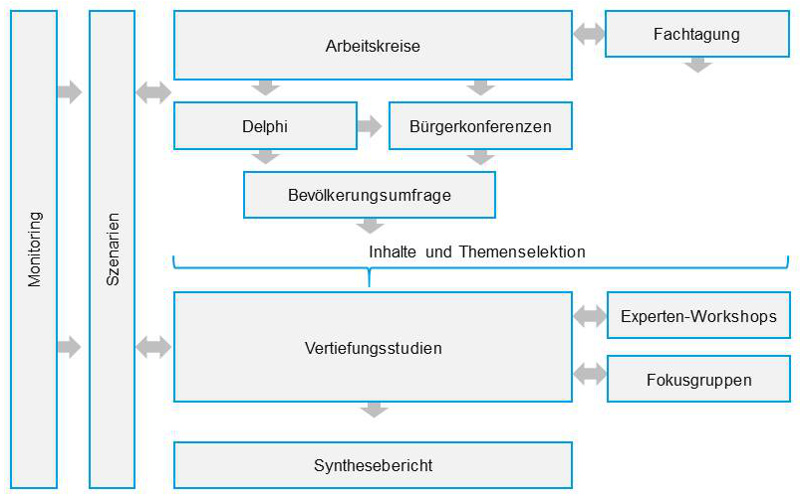
The project contributes to the discussion through a series of joint research processes, including social dialogue instruments. Therewith, it is intended to collect, create, deepen and disseminate knowledge about Big Data and its use:
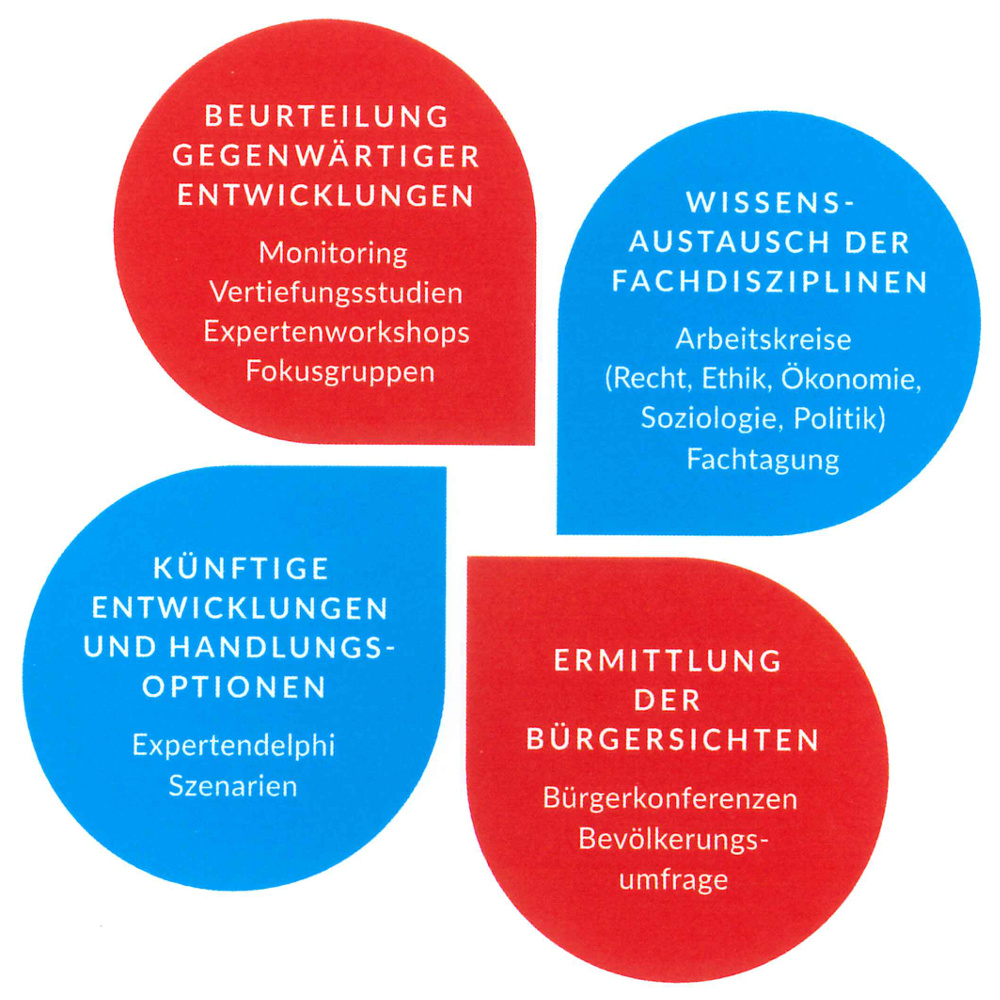
- Assessment of current developments: Within the project, the complex and often opaque developments in Big Data applications, data flows and business models will be continuously monitored, recorded and assessed. To determine and assess societal changes associated with Big Data, interdisciplinary in-depth studies will be set up, taking into account the findings and results of expert workshops and focus groups.
- Evaluation of citizens’ perceptions: In order to understand citizens’ estimations and expectations, three citizens’ dialogues will be held and a representative population survey will be carried out.
- Knowledge exchange across disciplines: The so far fragmented scientific knowledge will be brought together, further developed and shared across the different fields of social science research. It will then be used to assess specific Big Data developments. Specially established working groups in the fields of ethics, economy, sociology, law, and political science support this aim. Additionally, a nationwide symposium will be organised which offers opportunities for exchange to stakeholders working in research and development.
- Assessment of future developments and options for action: Finally, the results of the whole set of research instruments and the assessment and discussion of future developments in scenarios and in an expert delphi workshop will be used to develop options for political action, research and development.
Expert opinions
- Algorithmic Accountability
- Auswirkungen von Big Data auf den Markt der Onlinemedien
- Die öffentliche Verhandlung von Big Data in politischen Kampagnen
- Digitalisate zwischen Erklären und Verstehen
- Ethische Standards für Big Data und deren Begründung
- Für immer nnonym: Wie kann De-Anonymisierung verhindert werden?
- Big Data im Gesundheitsbereich
- Datenhandel und Plattformen
- Datenrechte - Eine Rechts- und Sozialwissenschaftliche Analyse im Vergleich Deutschland - USA
- Big Data as an Asset - Daten und Kartellrecht
- Digitale Transformation - Big Data Im Öffentlichen Personenverkehr
- Arbeit 4.0 - People Analytics - Führungsinformationssysteme
- Bildung für und über Big Data
- Gutachten zum Thema "Handel und Elektronische Bezahlsysteme"
Publications
Sind Heuristiken die besseren Algorithmen? Ein Antwortversuch am Beispiel des Traveling Salesman Problem (TSP)
2020. Datafizierung und Big Data. Ethische, anthropologische und wissenschaftstheoretische Perspektiven. Hrsg.: Klaus Wiegerling, Michael Nerurkar, Christian Wadephul, S. 55–93, Springer Fachmedien Wiesbaden. doi:10.1007/978-3-658-27149-7_3
Datafizierung und Big Data : Ethische, anthropologische und wissenschaftstheoretische Perspektiven
2020. VS Verlag für Sozialwissenschaften
Datensouveränität ohne Datenkompetenz? Ergebnisbericht aus dem AK Ethik des BMBF-Projekts ABIDA
2020. Ringvorlesung ‚Data Literacy‘, ZAK (2020), Karlsruhe, Germany, January 8, 2020
Einstellungen und Erwartungen
2019. Big Data : Gesellschaftliche Herausforderungen und rechtliche Lösungen. Hrsg.: B. Kolany-Raiser, 9–30, Verlag C.H.Beck
Gesellschaftliche und ethische Folgen der digitalen Transformation des Gesundheitswesens
2019. Gesundheit digital : Perspektiven zur Digitalisierung im Gesundheitswesen. Hrsg.: R. Haring, 213–227, Springer-Verlag. doi:10.1007/978-3-662-57611-3_12
Big Data - Gesellschaftliche Herausforderungen und rechtliche Lösungen
2019. Verlag C.H.Beck
Digitalisierung als Prozess. Ethische Herausforderungen inmitten allmählicher Verschiebungen zwischen Mensch, Technik und Gesellschaft
2019. Zeitschrift für Wirtschafts- und Unternehmensethik, 20 (2), 121–145. doi:10.5771/1439-880X-2019-2-121
Digitalisierung und Datafizierung. Von Erwartungen und Sorgen, Illusionen und Möglichkeiten
2019. Interdisziplinäre Tagung ’Datafizierte Gesellschaft: Praktiken, Prozesse und Folgen der Datafizierung’ (2019), Bonn, Germany, September 24–25, 2019
Digitalisierung gestalten - Plädoyer gegen den grassierenden Fatalismus
2019. International School Progress in Hydrogen Safety (2019), Hildesheim, Germany, June 26, 2019
Digitalisierung und Ethik. Plädoyer für digitale Mündigkeit
2019. Ambassador Club (2019), Baden-Baden, Germany, June 29, 2019
Digitale Zukünfte - wo bleibt der Mensch?
2019. Philosophische Gesellschaft (2019), Bremerhaven, Germany, June 27, 2019
Digitale Zukünfte - ist der Mensch trotz aller Kreativität letztlich unterlegen?
2019. Zukunftskongress und Zukunftsfestival: Next Frontiers. Applied Fiction Days (2019), Stuttgart, Germany, June 28, 2019
Digitale Mobilität: Herausforderungen für Technikgestaltung in der Datengovernance
2019. Inputkonferenz Projekt DatDigMob (2019), Stuttgart, Germany, May 21, 2019
Chancen, Risiken und Illusionen der Digitalisierung
2019. Friedrich Ebert Stiftung (2019), Stuttgart, Germany, February 1, 2019
Demokratie und Digitalisierung - privat betriebene Netzwerke machen Politik
2019. CIVIS Medienkonferenz (2019), Berlin, Germany, January 10, 2019
Digitale Zukunft - wo bleibt der Mensch?
2019. Workshop Universität Bielefeld (2019), Bielefeld, Germany, January 17, 2019
Der unterlegene Mensch, oder: die Herausforderung digitaler Mündigkeit
2019. Diskussionsveranstaltung MdB Christmann (2019), Stuttgart, Germany, February 27, 2019
Der unterlegene Mensch, oder: die Herausforderung digitaler Mündigkeit
2019. Vortragsveranstaltung Gemeinde Wächtersbach (2019), Wächtersbach, Germany, April 10, 2019
Der Aufstieg der digitalen Maschinen - Notwendigkeit neuer ethischer Leitlinien?
2019. Big Data & Künstliche Intelligenz (2019), Frankfurt am Main, Germany, May 27, 2019
Technikfolgenabschätzung zur Digitalisierung - ethische Aufklärung statt Moralisierung
2019. Vorstandskonferenz Vertrieb der DGV (2019), Berlin, Germany, March 13, 2019
Künstliche Intelligenz - wo bleibt der Mensch?
2019. Regionalkonferenz (2019), Augsburg, Germany, March 26, 2019
Digitale Zukünfte - ist der Mensch trotz aller Kreativität letztlich unterlegen?
2019. Kreativkonferenz (2019), Karlsruhe, Germany, April 11, 2019
Machen wir uns mit der Digitalisierung selbst überflüssig? Ein Plädoyer für digitale Mündigkeit
2019. Samstags-Uni: Die digitale Revolution (2019), Freiburg, Germany, May 18, 2019
Software als Institution? Eine ethisch-normative Perspektive auf Big Data
2019. Ringvorlesung "Alles außer Kontrolle? Herausforderungen der Digitalisierung für die Gesellschaft" (2019), Passau, Germany, January 8, 2019
Technology Assessment of Information and Communication Technologies
2018. Encyclopedia of Information Science and Technology. Ed.: M. Khosrow-Pour, 4267–4277, IGI Global. doi:10.4018/978-1-5225-2255-3.ch370
Big Data in der Wissenschaft
2018. Big Data und Gesellschaft : Eine multidisziplinäre Annäherung. Hrsg.: B. Kolany-Raiser, 17–32, Springer Fachmedien Wiesbaden
Attitudes towards big data practices and the institutional framework of privacy and data protection - A population survey (KIT Scientific Reports ; 7753)
2018. KIT Scientific Publishing. doi:10.5445/KSP/1000086677
Big Data - quo vadis? Trends, Treiber, Determinanten, Wildcards
2018. Karlsruher Institut für Technologie (KIT). doi:10.5445/IR/1000082069
Ethische Folgen der Digitalisierung und Technologisierung
2018. Führung in der digitalen Arbeitswelt (2018), Bad Dürkheim, Germany, October 12, 2018
Algorithmen statt mündiger Mensch?
2018. Netzdialog. Literaturforum im Brecht Haus (2018), Berlin, Germany, December 20, 2018
Grenzen auf dem Weg ins digitale Glück? Zur Ethik der Digitalisierung
2018. Katholische Hochschulgemeinde (2018), Karlsruhe, Germany, December 11, 2018
Schöne digitale Zukunft - wo bleibt der Mensch?
2018. 3. Netzwerktreffen Industrie 4.0 (2018), Bühl, Germany, November 28, 2018
Ethik der Digitalisierung - wo bleibt der Mensch?
2018, November 6. Volksbank Staufen (2018), Bad Krozingen, Germany, November 6, 2018
Ethische Fragen der Digitalisierung
2018. Management Schulung, VDV Stiftung (2018), Berlin, Germany, October 27, 2018
Digitalisierung: Herausforderungen für Ethik und Menschenbild
2018. Digitale Kulturrevolution : Tagung der Stiftung Centesimus Annus, Köln,17.Oktober 2018
Ethik und Digitalisierung
2018. 22. Investment Dialog der DZ Bank (2018), Frankfurt am Main, Germany, September 12, 2018
ABIDA - Assessing big data: Projektüberblick und ausgewählte Ergebnisse
2018. Künstliche Intelligenz, Big Data und digitale Gesellschaft : Herausforderungen für die politische Bildung (2018), Bonn, Germany, March 2–3, 2018
Transformation der Wissenschaft
2018. ABIDA Gutachterworkshop (2018), Siegen, Germany, February 13, 2018
Bayes-Netze - methodische Stärke trotz epistemischer Schwäche?
2018. Workshop "Theorie und Praxis Datenintensiver Wissenschaften" (2018), Karlsruhe, Germany, November 15, 2018
The Magic of Blockchain: A Look behind the Scences of three Smart Contract based Flagship Projects
2018. Workshop "We are on a mission" (2018), Berlin, Germany, April 27, 2018
Bots, Big Data und Vertrauen
2018. Symposion „Bots or not Bots? Politik, Demokratie & Wahlen im Zeitalter ihrer digitalen Produzierbarkeit" (2018), Linz, Austria, April 26–27, 2018
Big data in der Digitalen Informationsgesellschaft
2018. 40 Jahre Landinformationssysteme, Geodateninfrastrukturen, Digitalisierung, IKGIS Workshop (2018), Darmstadt, Germany, March 7, 2018
Big Data - Lösung oder Problem? Dokumentation und Analyse der Bürgerkonferenzen
2017. Karlsruher Institut für Technologie (KIT)
Nutzerzentrismus und Vertrauen in Big Data-Anwendungen
2017. ABIDA Workshop ’Big Data - die digitale Konstruktion sozialer Wirklichkeiten’, Dortmund, 15.-16.März 2017
Technikfolgenabschätzung, Werte und Big Data
2017. Norm und Normierung von Human Cyber-Physical Systems (HCPS) : Ethische, soziale und rechtliche Aspekte, Oldenburg, 4.Februar 2017
Big data auf dem Bauernhof - smart farming
2016. Big Data zwischen Kausalität und Korrelation : Wirtschaftliche und rechtliche Fragen der Digitalisierung 4.0. Hrsg.: T. Hoeren, 127–141, LIT Verl
Big Data - Anspruch, Wirklichkeit und Ideologie
2016. #sustainability – Wirtschaftsethische Herausforderung Digitalisierung : Impulse einer neuen Generation. Hrsg.: J. H. Quandt, 15–27, Rainer Hampp Verlag
Algorithmische Subpolitik: Big Data als Technologisierung kollektiver Ordnungsbilgung?
2016. Berliner Debatte Initial, 27 (4), 66–76
Values and networks - steps toward exploring their relationships
2016. ACM SIGCOMM Computer Communication Review, 46 (2), 25–31. doi:10.1145/2935634.2935640
Führt Big Data zur abduktiven Wende in den Wissenschaften?
2016. Berliner Debatte Initial, 27 (4), 35–49
Ethics of big data : Introduction
2016. International review of information ethics, 24 (5), 2–4
Assessing societal aspects of big data - the project ABIDA
2016. The Challenge of Big Data in Science : 5th International LSDMA Symposium, Karlsruhhe, October 5, 2016
Diktatur der Transparenz?
2016. 12 Köpfe, Wie transparent bin ich?, Hochschule für Polizei Baden-Württemberg, VIllingen-Schwenningen, 22.Juni 2016
ABIDA - Assessing big data
2016. Workshop ’Data Lakes - Steht eine Springflut bevor?’, Berlin, 13.April 2016
Die Undurchsichtigkeit der Transparenz
2016. Smart New World - Was ist smart an smarten Technologien? Internationale Konferenz (TA16), Wien, A, 30.Mai 2016
Alles vernetzt, alles smart - Soziale Herausforderungen automatisierter Entscheidungen
2016. Bad Herrenalber Gespräche ’autonom - vernetzt - gesteuert’, Bad Herrenalb, 30.Januar 2016
Bürgerbeteiligungsverfahren in der praktischen Umsetzung
2016. 7. internationale Tagung des Netzwerks Technikfolgenabschätzung (NTA7), Bonn, 16.-18.November 2016
IT-Politik zwischen Neuland, Standortförderung und "Technologischem Totalitarismus". Perspektiven und Implikationen für eine TA von KIT
2016. Digitaldebatte der AG Big Data, Karlsruhe, 14.01.2016
Predictive policing: Polizeiliche Verbrechensvorhersage - hier, heute und in Zukunft?
2016. Veranstaltungsreihe “12 Köpfe, 12 kontroverse Positionen, eine Herausforderung: Die digitale Revolution” (2016), Karlsruhe, Germany, February 18, 2016
Hot spot societies: The urban space as a ’projection screen’ for data-driven crime prevention and law enforcement
2016. 3rd ISA Forum of Sociology (2016), Vienna, Austria, July 10–14, 2016
Predictive Policing - Strafverfolgung und Gefahrenabwehr in Zeiten von Big Data - als Forschungsgegenstand
2016. Kolloquium des Arbeitsbereichs Recht und Gesellschaft, AG Rechtssoziologie der Fakultät für Soziologie an der Universität Bielefeld, Bielefeld, 4.Mai 2016
Predictive Policing - Auf Spurensuche in der Zukunft. Oder: Wenn eine Big Data Vision gesellschaftsfähig wird
2016. Treffen des Arbeitskreises Soziologie des ABIDA-Projekts, Dortmund, 27.Juni 2016
Big Data: Digitalisierung und Datafizierung als Herausforderung für die Schulbildung
2016. 9. Magdeburger Theorieforum: Big Data: Implikationen für Bildung/Medienbildung und Gesellschaft (2016), Magdeburg, Germany, July 8–9, 2016
Big Data - Wirklichkeit, Anspruch und Ideologie
2016. Hochschule Konstanz (2016), Konstanz, Germany, October 17, 2016
Big Data und technische Autonomie aus informationsethischer Sicht
2016. Katholische Hochschule Freiburg, Campus Stuttgart, 28.Oktober 2016
Big Data - Anspruch, Wirklichkeit und Metaphysik
2016. Philosophische Fakultät der Universität Banja Luka, BIH, 6.Juni 2016
Big Data - Anspruch, Wirklichkeit und Ideologie
2016. Technische Universität München, 22.Juni 2016
Big Data Begleitforschung
2016. Smart Data Forum, Germany - Excellence in Big Data, Berlin, 20.06.2016
Bürgerkonferenzen - Big Data und die Bevölkerung
2016. Big Data und Gesellschaft - Zwischen Kausalität und Korrelation : Interdisziplinäre Fachtagung des Projekts ABIDA, Münster, 15.-16.Februar 2016
Im Sog der Daten. Herausforderungen des ’Big Data-Zeitalters’
2015. ITAS Jahrbuch 2014/2015 Karlsruhe : Inst. für Technikfolgenabschätzung und Systemanalyse, Karlsruher Institut für Technologie, 2015, 52–55
Big Data und die gesellschaftlichen Folgen
2015. Technikfolgenabschätzung, Theorie und Praxis, 24 (2), 83–87
Big Data - Zwischen Innovationspotential und Schutz der Privatsphäre
2015. Vortr.: Hochschule Karlsruhe, 19.Mai 2015
Big Data Zukunftsszenarien in der TA und in der öffentlichen Debatte
2015. Zukunft - Macht - Technik : ITA-Jahreskonferenz, Wien, A, 1.Juni 2015
Smart. Vernetzt. Gläsern
2015. Vortr.: Technik.kontrovers Themenabend Smart. Vernetzt. Gläsern, Karlsruhe, 18. März 2015
Big Data und die Folgen für den Einzelnen
2015. Big Data Summit, Hanau, February 25, 2015
Big Data - Anspruch, Wirklichkeit und Ideologie
2015. Consulting Akademie Unternehmensethik 2015, Karlsruhe, 19.-22.November 2015
Big Data - Hype, hope, fear
2014. INFORMATIK 2014: Big Data - Komplexität meistern. 44. Jahrestagung der Gesellschaft für Informatik, Stuttgart, 22.-26. September 2014
Verschleierung elektronischer Kommunikation im Spiel der Kräfte
2014. INFORMATIK 2014: Big Data - Komplexität meistern. 44. Jahrestagung der Gesellschaft für Informatik, Stuttgart, 22.-26. September 2014
Contact
Karlsruhe Institute of Technology (KIT)
Institute for Technology Assessment and Systems Analysis (ITAS)
P.O. Box3640
76021 Karlsruhe
Germany
Tel.: +49 721 608-26815
E-mail
Dr. Carsten Orwat
Karlsruhe Institute of Technology (KIT)
Institute for Technology Assessment and Systems Analysis (ITAS)
P.O. Box 3640
76021 Karlsruhe
Germany
Tel.: +49 721 608-26116
E-mail