

Sustainability assessment of research on systems and technologies – integrative and transdisciplinary (NaBIT)
- Project team:
Baumann, Manuel (Project leader); Martina Haase, Laura Mesa Estrada, Christina Benighaus
- Funding:
KIT Strategy Fund
- Start date:
2026
- End date:
2028
- Project partners:
Institute for Thermal Energy Technology and Safety (ITES), KIT; Institute of Nanotechnology (INT), KIT
- Research group:
Project description
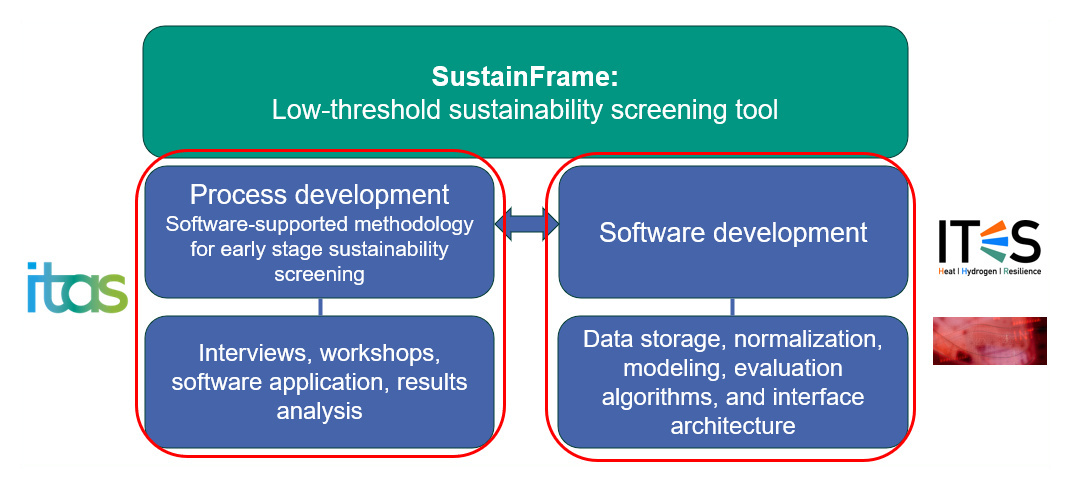
The NaBIT project develops a low-threshold screening tool called “SustainFrame” to assess the sustainability of new and ongoing research ideas and projects at KIT. SustainFrame involves the development of a software-supported methodology and the associated software (Fig. 1).
SustainFrame guides users through the screening process with a series of questions, which includes selecting alternatives and evaluation criteria, creating an evaluation matrix, weighting criteria, evaluating alternatives, analyzing results, and identifying areas for action.
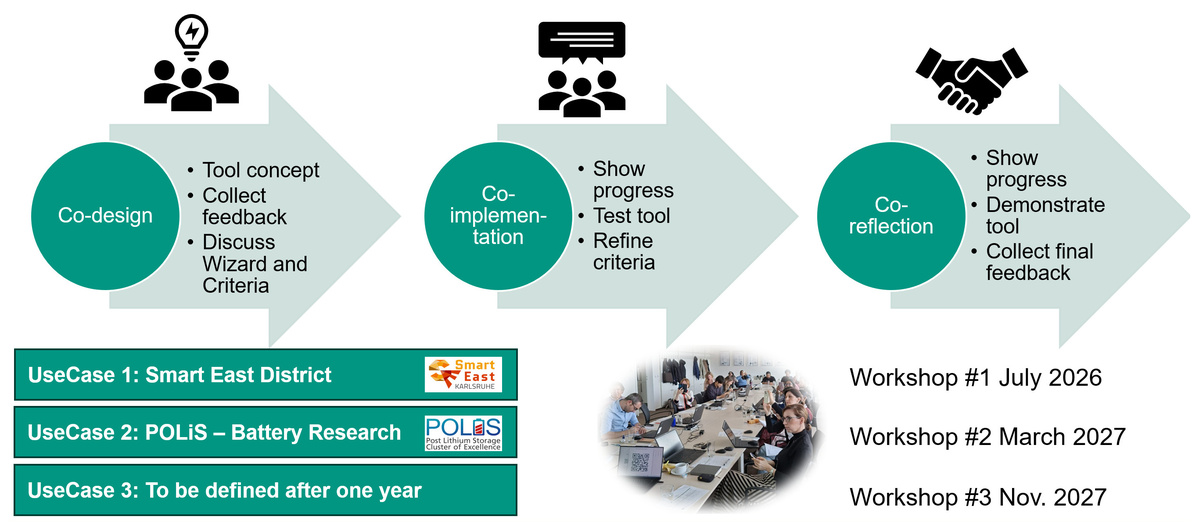
SustainFrame is developed building on exemplary use cases at KIT. These include POLiS, SmartEast, and a third use case yet to be defined. The use cases are integrated into the development of SustainFrame through interviews and three workshops (co-design, co-implementation, co-reflection).
SustainFrame is designed to help identify hotspots and areas for action, which can then be further examined using more detailed sustainability analysis methods.
ITAS focuses on developing the screening process as the foundation for software development and on integrating the use cases for co-design, co-implementation, and co-reflection within SustainFrame. This involves the use of multi-criteria decision analysis methods for problem structuring, criteria weighting and aggregation, as well as for evaluating alternatives and analyzing results.
Problem structuring primarily involves defining the evaluation criteria and alternatives for each use case. Following the value-focused thinking (VFT) approach, SustainFrame supports users in defining the criteria and associated attributes. This is done using predefined, context-specific sets of criteria, which users can adapt during the screening process. To evaluate the alternatives based on the developed criteria, an evaluation matrix is created that allows for both qualitative and quantitative entries based on, e.g., expert estimates or available data. Depending on the problem and available data, SustainFrame uses appropriate weighting and aggregation methods for evaluating the alternatives. In the case of a qualitative or semi-quantitative evaluation matrix, aggregation methods such as PROMETHEE II and ELECTRE III are available, which can be used in combination with the Deck of Cards weighting method to aggregate the criteria and determine a ranking of the alternatives.
Following a preliminary analysis of the screening process based on interviews, the process and the associated software are tested, further developed, and refined in a series of workshops, incorporating the aforementioned use cases.
SustainFrame is developed by exploiting synergies with existing KIT software solutions such as KaDi4Mat and HELDA.
Contact
Karlsruhe Institute of Technology (KIT)
Institute for Technology Assessment and Systems Analysis (ITAS)
P.O. Box 3640
76021 Karlsruhe
Germany
Tel.: +49 721 608-23215
E-mail