

Responsible Quantum Technologies
-
type of event:
Hybrider Workshop
-
place:
Karlsruhe, Online
-
date:
22.04.2026 - 24.04.2026
Responsible Quantum Technologies
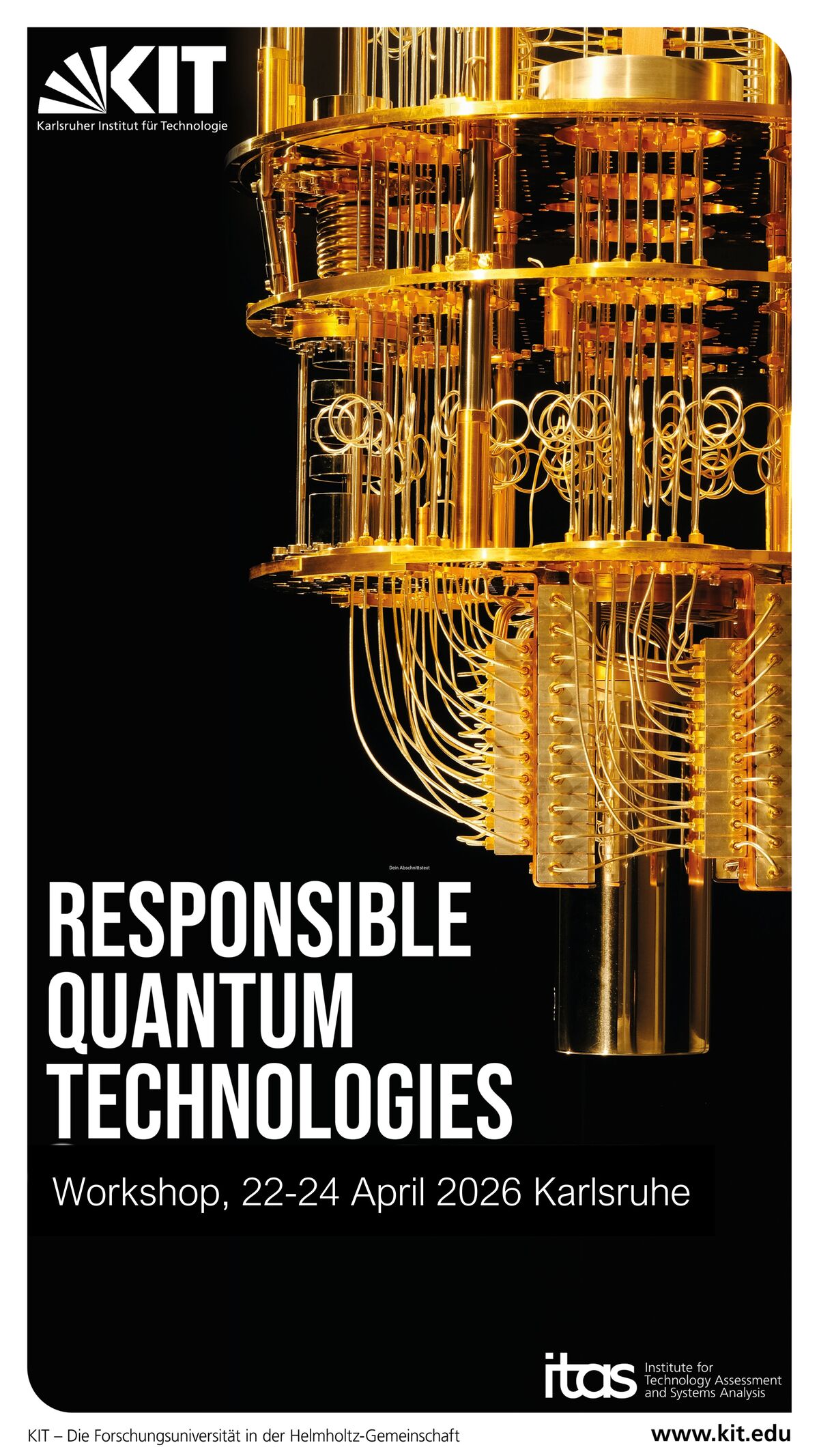
The second quantum revolution has been ongoing for more than two decades, and many countries around the globe have recognized the promises of these technologies. Just in the last decade, the number of publicly supported national initiatives has grown from zero to more than 30, with more than €50 billion in public investments allocated or planned worldwide. Both the number of new publications per year and patents granted in quantum technologies (QT) have been climbing steadily over the past decade, as has the number of start-ups being founded and established companies entering the field. Finally, the field has begun receiving attention from private funding sources in recent years, which some have called the ‘quantum gold rush’. Within two decades, QT has evolved from a topic mainly discussed at physics conferences into a strong contender for a potential future industry.
All this rapid development has triggered a kind of quantum ‘race’, in which countries, companies, and institutions compete to be the first to reach certain checkpoints or to lead in specific quantum benchmarks. However, many also note that the truly transformative effects of QT on society will materialize in the long term. In this respect, we would like to initiate a discussion on responsibility and introduce QT as a noteworthy emerging topic for technology assessment (TA) studies.
This workshop aims to be another step toward establishing connections between the QT and TA communities and to introduce current discussions within the QT community to a new audience. It is organized as a part of the QuTec project under KIT-ITAS.
You can find additional information on and the video recordings of the 2021, 2022, 2023, 2024, and 2025 events of this series by clicking on the dates.
Contact
Zeki Seskir (zeki.seskir∂kit.edu)
Registration
If you would like to attend this event, register here.
Program
The overview of the event agenda for this year is provided below:
22.04.2026 - Wednesday (First Day)
| 09:30 - 10:00 | Registration |
| 10:00 - 11:20 | Responsible QT Efforts 1 Chair: Zeki C. Seskir (KIT-ITAS) Julia Thiele (Amazon Web Services) Natasha Oughton (UK NQCC) Audrey Himmer (Open Quantum Institute / CERN) |
| 11:20 - 11:40 | Short break |
| 11:40 - 13:00 | Responsible QT Efforts 2 Chair: Audrey Himmer (Open Quantum Institute / CERN) Laetitia Ramelet (TA-Swiss) María A. Barea (TU Delft/Quantum Delta NL) Fabienne Marco (TUM/QSL, TransforM, QuantWorld) |
| 13:00 - 14:00 | Lunch |
| 14:00 - 15:20 | Responsible QT Efforts vol.3 Chair: Adrian Schmidt (KIT-ITAS) Zeki C. Seskir (ITAS) Ignacio Descazeaux (Copenhagen Business School) Isabelle Lacroix (Université de Sherbrooke) Yasser Omar (Portuguese Quantum Institute) |
| 15:20 - 15:40 | Short break |
| 15:40 - 17:00 | QT - Life and Health Tech. Chair: Christopher Coenen (ITAS) Maria Maia (ITAS) Marion Brickwedde (Charité - University Medicine Berlin) Amy Warnock (Q-BIOMED) |
23.04.2026 - Thursday (Second Day)
| 10:00 - 11:20 | Narratives Session Part 1 Chair: Adrian Schmidt (ITAS) Rüdiger Heinze (TU Braunschweig) Christian Kehrt (TU Braunschweig) Gina-Maria Pöhlmann (University of St. Gallen) & Jasmin Stein (TUM) Arnaud De Vellis (Université de Sherbrooke/Université de Grenoble) Henry Bennie (UWE Bristol) |
| 11:20 - 11:40 | Short break |
| 11:40 - 13:00 | Narratives Session Part 2 & Group Discussion Chair: Gina-Maria Pöhlmann (University of St. Gallen) Rainer Müller (TU Braunschweig) Zrinka Stimac (Leibniz Institute for Educational Media) Adrian Schmidt (ITAS) |
| 13:00 - 14:00 | Lunch |
| 14:00 - 15:20 | QT - Space & Defence Chair: Zeki C. Seskir (ITAS) Rebecca Mossop (DLR) Nicolas Ayala Arboleda (Novaspace) Michal Krelina (SIPRI) Anna Beata Kalisz Hedegaard (QSECDEF / QuantumPrime) |
| 15:20 - 15:40 | Short break |
| 15:40 - 15:50 | Announcement of Recommendations (Hinting for Friday) Moderator: Pieter Vermaas (TU Delft) |
| 15:50 - 17:00 | Capacity Building Session Chair: Tobias Denzler (QAI Ventures) Tobias Denzler (QAI Ventures) Harris Mubeen (Kiutra) Pieter Vermaas (TU Delft/Quantum Delta NL) |
| 18:30 - 22:00 | Conference dinner (at Ristorante Rosa Bianca - Douglasstraße 11-13) |
24.04.2026 - Friday (Third Day)
| 10:00 - 11:20 | QT - Emerging Applications Chair: Adrian Schmidt (ITAS) Jennifer Brettschneider (HU Berlin) Sara Hejazi (Bruno Kessler Foundation, Center for Sensors & Devices) Chie Endo (Fraunhofer ISI) Shamira Ahmed (Data Economy Policy Hub (DepHUB)/TU Delft) |
| 11:20 - 11:40 | Short break |
| 11:40 - 13:00 | Outreach and Science Communication Chair: Natasha Oughton (UK NQCC) Daisy Shearer (UK NQCC) Nadine Weber (Stuttgart Media University) Pranoti Kshirsagar (The Science Talk) Fabienne Marco (TUM/QSL, TransforM, QuantWorld) |
| 13:00 - 14:00 | Lunch |
| 14:00 - 15:20 | Recommendations for Report in Progress Moderator: Pieter Vermaas (TU Delft/Quantum Delta NL) |
| 15:20 - 15:40 | Short break |
| 15:40 - 17:00 | Future Steps & Closing Moderator: Zeki C. Seskir (KIT-ITAS) |
Shaping the Quantum Future: Narratives in the Second Quantum Revolution
The second quantum revolution is not only a scientific and technological endeavor, but also a profoundly narrative one. Visions and collective imaginaries shape how quantum technologies (QT) are researched, funded and governed, influencing strategic priorities and public perception. This session explores the role of narratives as drivers of technological development, highlighting their particular relevance in a field as complex and future-oriented as QT. Taking a historical perspective, the session reflects on how earlier technological transformations were accompanied by guiding stories of progress, security or growth, and how similar patterns appear in current quantum discourse. It examines narratives in contexts such as education and innovation policy, and discusses how they frame expectations regarding skills, impact and societal value. The session will conclude with thematic discussions on ongoing developments in responsible quantum innovation and on how more inclusive narratives can support a sustainable ecosystem.
Capacity Building in Responsible QT Session
Despite the quantum industry’s increasing maturity, its development is still largely driven by academia and startups which in the light of the high ongoing geopolitical fragmentation combined with the unusually long and expensive development cycles of quantum technologies are faced with many challenges. For that reason it becomes more crucial to understand the interplay of the public and private sector in supporting capacity building beyond direct financial funding. This session aims at exploring how ethical, legal and social aspects (ELSA) in the quantum industry can be strengthened and in turn provide support to the ecosystem. Topics to be explored are how to support businesses to navigate export controls, stricter supply chain guidelines and dual-use of quantum. The results are to be aggregated to a proposal to the European Commission for the European Quantum Act and EU Quantum Flagship.